
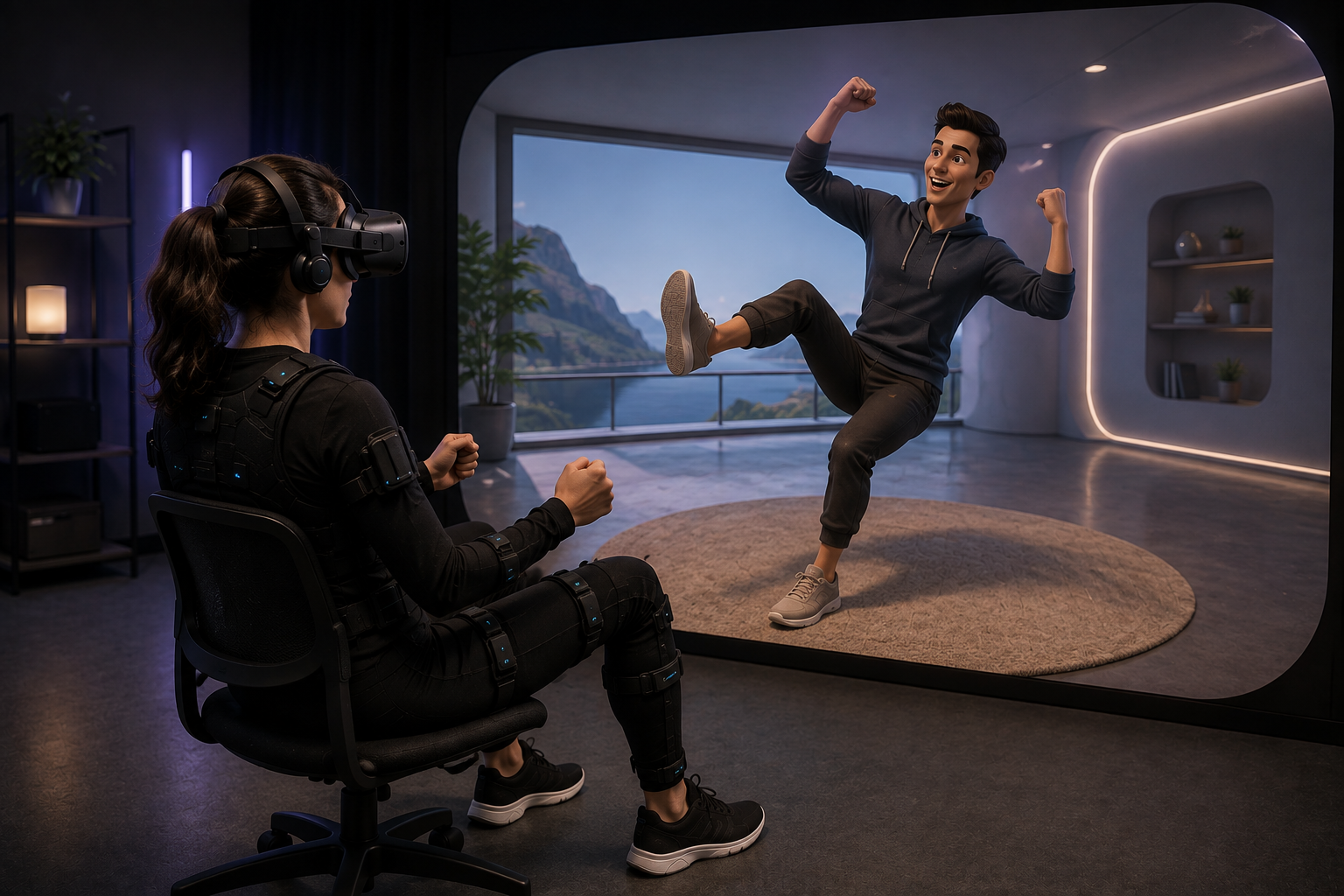
In Virtual Reality, strong embodiment is usually achieved by making an avatar closely reproduce the user’s physical movements. But what happens when the virtual body does not move in the same way as the real body? Can haptic feedback help users accept unfamiliar virtual movements as their own?
In this project, the student will develop an immersive VR experience using a bHaptics suit to investigate whether carefully designed tactile feedback can strengthen embodiment when there is a mismatch between a user’s real movements and those of their avatar. For example, a participant might remain stationary while their avatar walks, make a small movement while the avatar performs an exaggerated version, or control an avatar whose movement incorporates the motion style of another person.
The student will explore different mappings between physical movement, virtual movement and haptic sensation. Haptic patterns could be synchronised with the avatar’s actions, allowing the user to feel events associated with movements they are not physically performing. The project could investigate the limits of this illusion by systematically varying the amount of motion mismatch and the timing, location or intensity of the haptic feedback.
A VR experiment will investigate whether haptic feedback can increase body ownership, agency and presence, and whether it allows users to embody virtual movements that differ more substantially from their own.
The project combines VR, haptics, character animation and human perception, and would suit a student with strong Unreal Engine 5 and programming skills.