
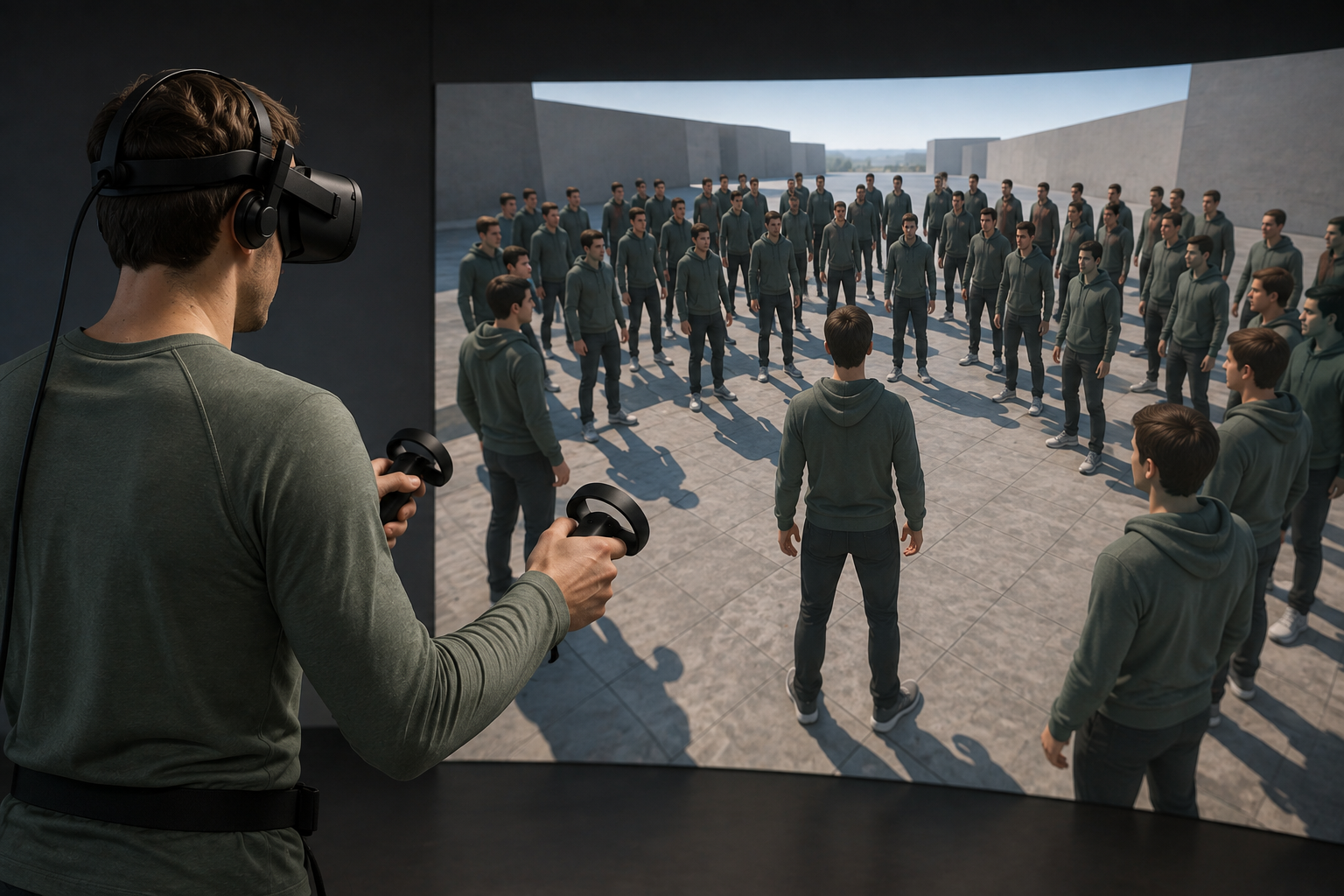
How we move through a crowd is influenced not only by where other people are, but also by how we perceive them. This project will investigate whether the appearance and proximity of virtual people influence how users behave when navigating through a crowd in Virtual Reality.
The student will develop a VR crowd environment in Unreal Engine and systematically manipulate a small number of crowd characteristics, focusing on clothing/appearance and interpersonal proximity. For example, the same virtual characters could be presented with different styles of clothing or social appearance, while the spacing between members of the group is varied. Participants will be given a simple navigation task, allowing us to measure behavioural responses such as the path they choose, whether they pass through or around a group, walking speed, and the distance they maintain from virtual characters.
The project builds on our previous work showing that avatar clothing and user personality can influence group dynamics in VR, and on research into the Proteus Effect, which demonstrates that characteristics of virtual representations can influence user behaviour. A particularly relevant study by Bruneau, Olivier and Pettré investigated whether people chose to move through or around groups of virtual characters, manipulating group density and appearance using ordinary characters, zombies and soldiers.
The project will investigate whether more subtle and socially meaningful manipulations of virtual character appearance, such as clothing and group composition, similarly affect users’ navigation and interpersonal behaviour.
The project combines real-time graphics, virtual humans, VR and human perception, and would suit a student taking modules in Real-Time Animation and/or Virtual Reality.