
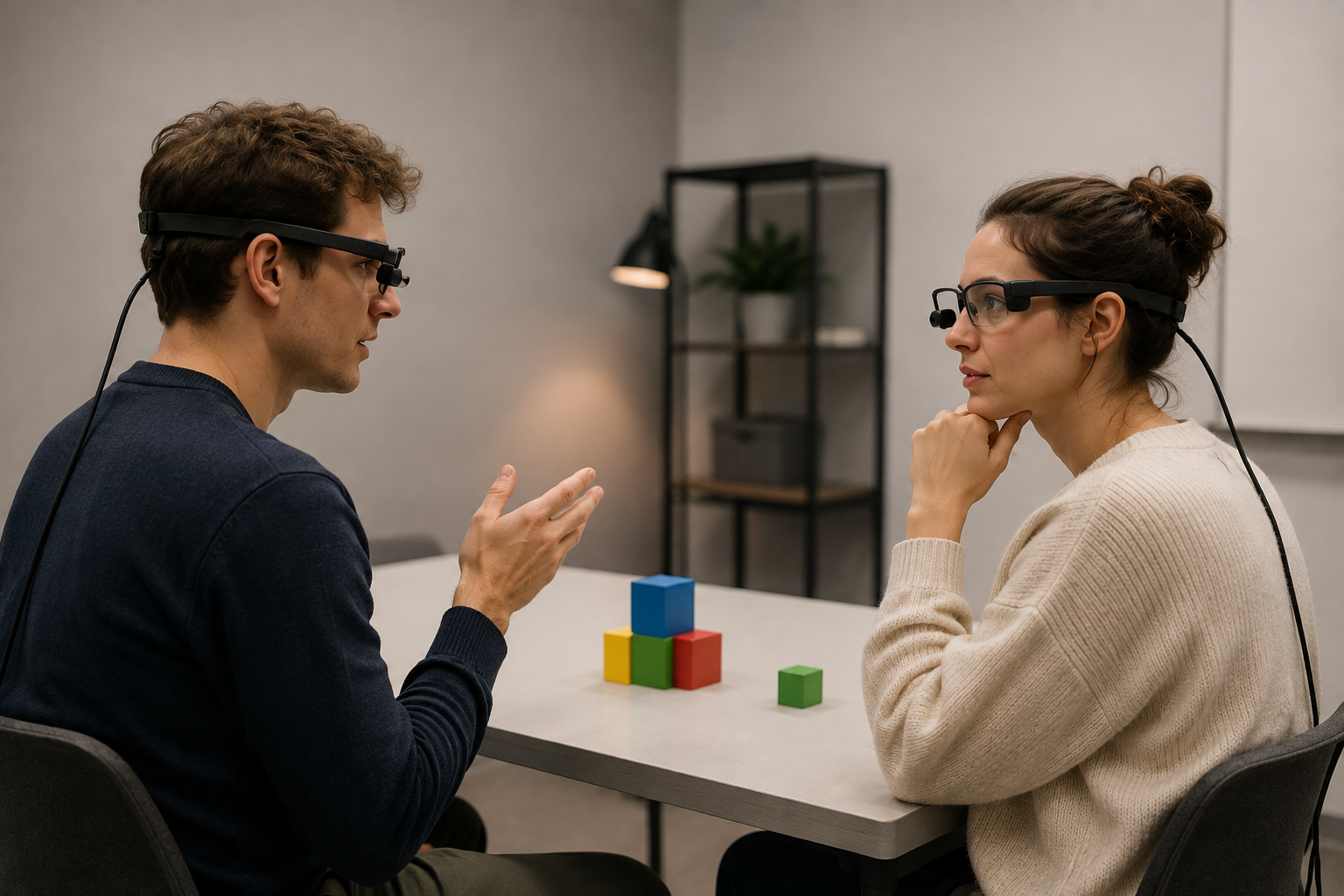
Eye gaze plays a fundamental role in face-to-face communication, signalling attention, engagement, turn-taking and social intent. However, gaze is often studied from the perspective of only one participant. This project will create a new dataset of synchronised eye movements from pairs of people engaged in natural social interactions, using two wearable Pupil Labs eye-tracking headsets.
Pairs of participants will take part in a series of controlled and natural conversational tasks while both participants’ gaze, first-person video, head movement and audio are recorded simultaneously. The dataset could include behaviours such as speaking and listening, mutual gaze, gaze aversion, joint attention, turn-taking and looking towards objects or other points of interest.
The student will develop a processing and annotation pipeline to automatically identify where each participant is looking, including the other person’s eyes, face and body, and objects in the environment. Pupil Labs already provides tools for mapping gaze onto facial landmarks and body regions, providing a useful starting point for this analysis. The two synchronised streams could then be used to identify higher-level behaviours such as eye contact, gaze following and reciprocal gaze patterns.
The resulting dataset will be analysed to investigate how gaze behaviour changes between speaker and listener roles, and whether characteristic gaze patterns can predict conversational events such as a change of speaker or joint attention.
The project combines eye tracking, computer vision, multimodal data analysis and social interaction, and would suit a student interested in computer vision, virtual humans or human behaviour.