
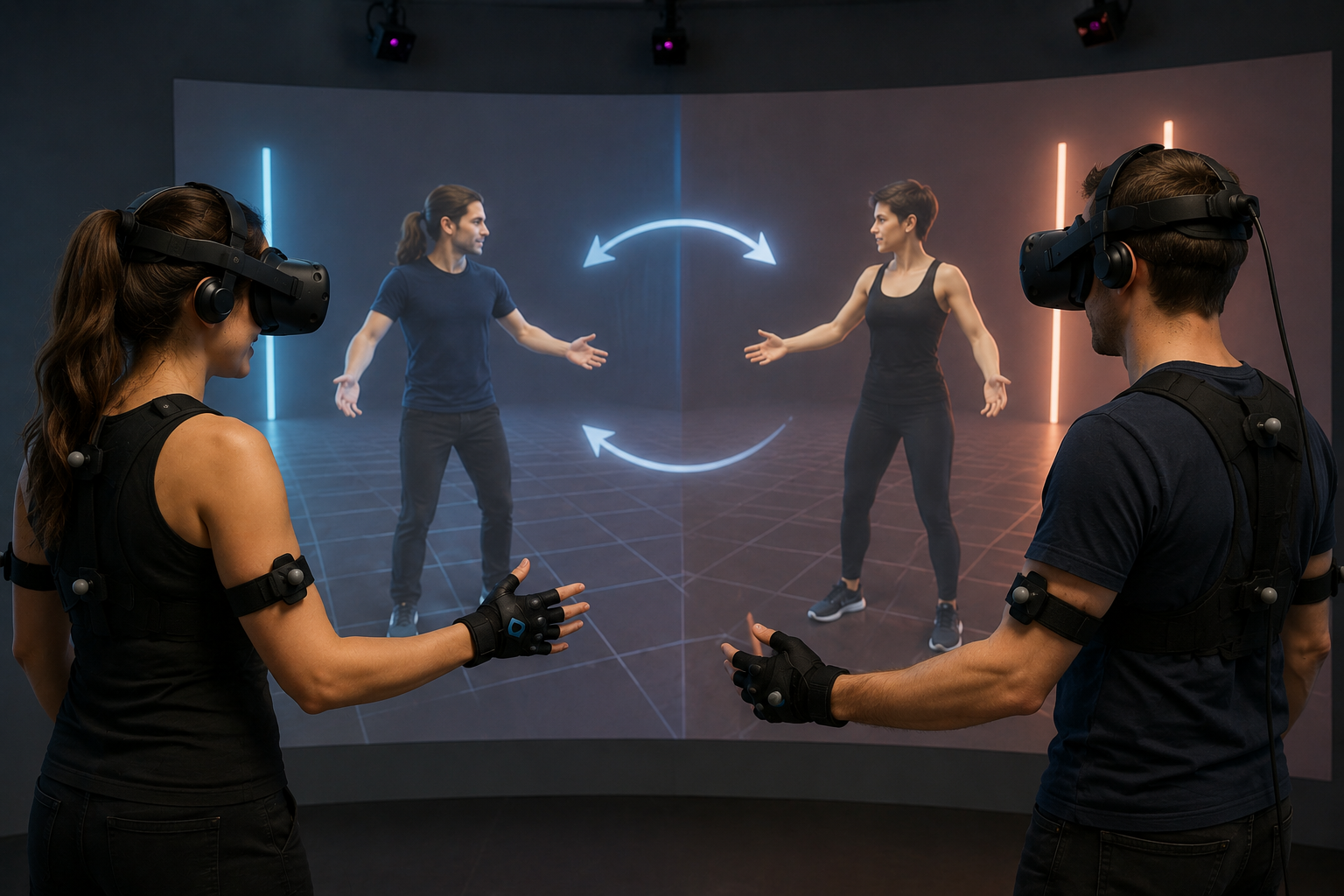
In Virtual Reality, users typically expect their avatar to both look and move like them. But what happens when your virtual body responds to your actions while moving with the motion style of somebody else, or when your appearance is replaced by a highly realistic digital double of another person?
In this project, the student will develop a real-time character animation system that uses machine learning to generate full-body avatar motion from sparse VR tracking. The project will build on techniques such as Learned Motion Matching and more recent neural approaches to embodied character control, which generate realistic full-body motion from sparse user inputs.
The system will investigate motion-based body swapping, where a user’s movements control an avatar but the generated animation incorporates motion captured from another performer. The student will also explore different ways of representing the swapped body, ranging from conventional mesh-based avatars to emerging Gaussian-splatting digital humans, to investigate whether increasingly realistic representations strengthen or disrupt the body-swap illusion.
A VR experiment will examine how changes in motion identity and visual realism influence embodiment, body ownership and agency. Does an avatar still feel like your body when it responds correctly to your actions but moves like somebody else? Does a photorealistic digital double of another person make the body swap more convincing, or make mismatches in movement more noticeable?
The project combines machine learning, character animation, neural rendering, Unreal Engine 5 and Virtual Reality. Students must be taking Real-Time Animation and a Machine Learning module, and should have strong programming skills and experience with Unreal Engine 5 and machine learning.