
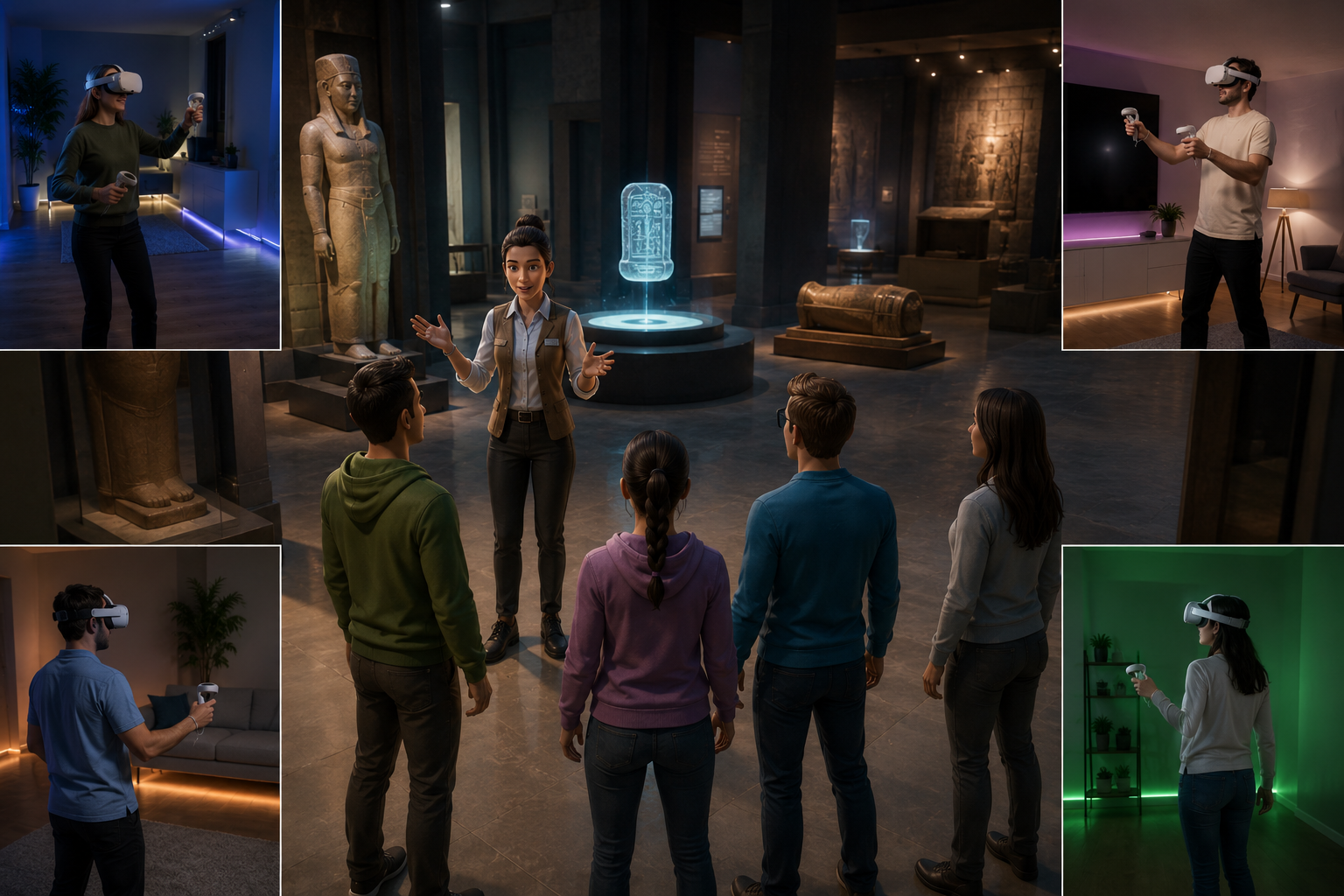
Imagine visiting a virtual museum as a family after closing time, where the exhibits have mysteriously come to life and an AI-driven virtual museum guide needs your group’s help to discover what has happened. This project will develop a short multiplayer VR experience for 3–4 players, in which a MetaHuman guide dynamically responds to the movement and behaviour of the group.
The guide will have pre-scripted dialogue and performances, which can be created using actors and Unreal Engine’s MetaHuman Animator, including body and facial animation captured from monocular video. The main challenge will be making these performances socially adaptive: the character should decide who to approach and address, where to stand, who to look at, and how to adapt its movement, gestures, eye contact and delivery depending on the players. For example, it might crouch or alter its behaviour when addressing a child, turn towards someone who discovers an artefact, or gather the family together before revealing the next part of the story.
The student will explore different approaches to generating this adaptive character behaviour, potentially using Motion Matching, Epic’s new AnimGen generative animation framework, procedural gaze and animation blending, or a combination of techniques. The aim is to investigate how existing and emerging animation technologies can be combined to create a virtual character that appears genuinely aware of and responsive to a small social group.
The student will also create a short interactive “Museum After Dark” scenario. Existing Unreal environments and assets can be used, while unusual exhibits and story objects could be created using generative AI image-to-3D tools, allowing the focus to remain on character interaction rather than extensive content modelling.
A user study could investigate whether the adaptive guide makes the multiplayer experience feel more engaging, socially aware and believable than a conventionally scripted virtual character.
The project combines multiplayer VR, AI, MetaHumans, character animation and social interaction, and would suit a student with strong Unreal Engine 5 and programming skills.